
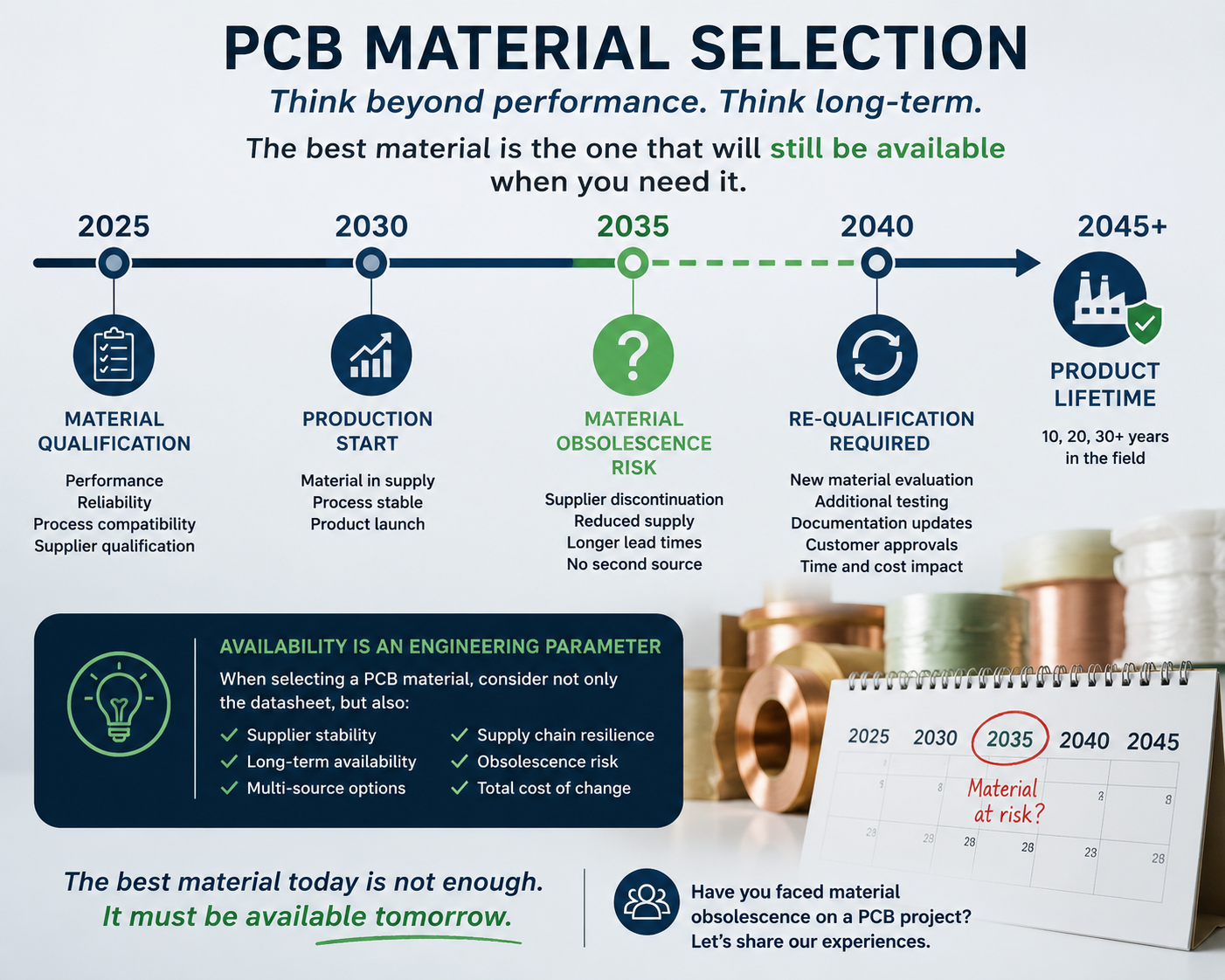
Following my recent posts on PCB materials, I was reflecting on a question that is often overlooked during material selection:
👉 Is the best material really the one with the best technical performance?
As engineers, we naturally focus on specifications:
- Tg
- Dk / Df
- Thermal conductivity
- Reliability
- Mechanical performance
But for products expected to remain in service for decades, another parameter can become just as important:
Availability.
A PCB laminate, prepreg or copper foil may offer excellent performance today, but what happens if it disappears from the market in five or ten years?
In many industries, replacing an obsolete material can trigger qualification campaigns, additional testing, documentation updates and significant engineering effort.
Sometimes, the cost of requalification exceeds the cost of the material itself.
This is why material selection should not only be a technical decision.
It should also consider long-term availability, supplier stability and supply chain resilience.
In the end, the “best” material is not always the one with the most impressive datasheet.
It is often the one that will still be there when you need it.
What are your thoughts? Have you ever faced a material obsolescence issue on a PCB project?
#PCB #PCBA #PCBMaterials #Engineering #SupplyChain #Reliability