
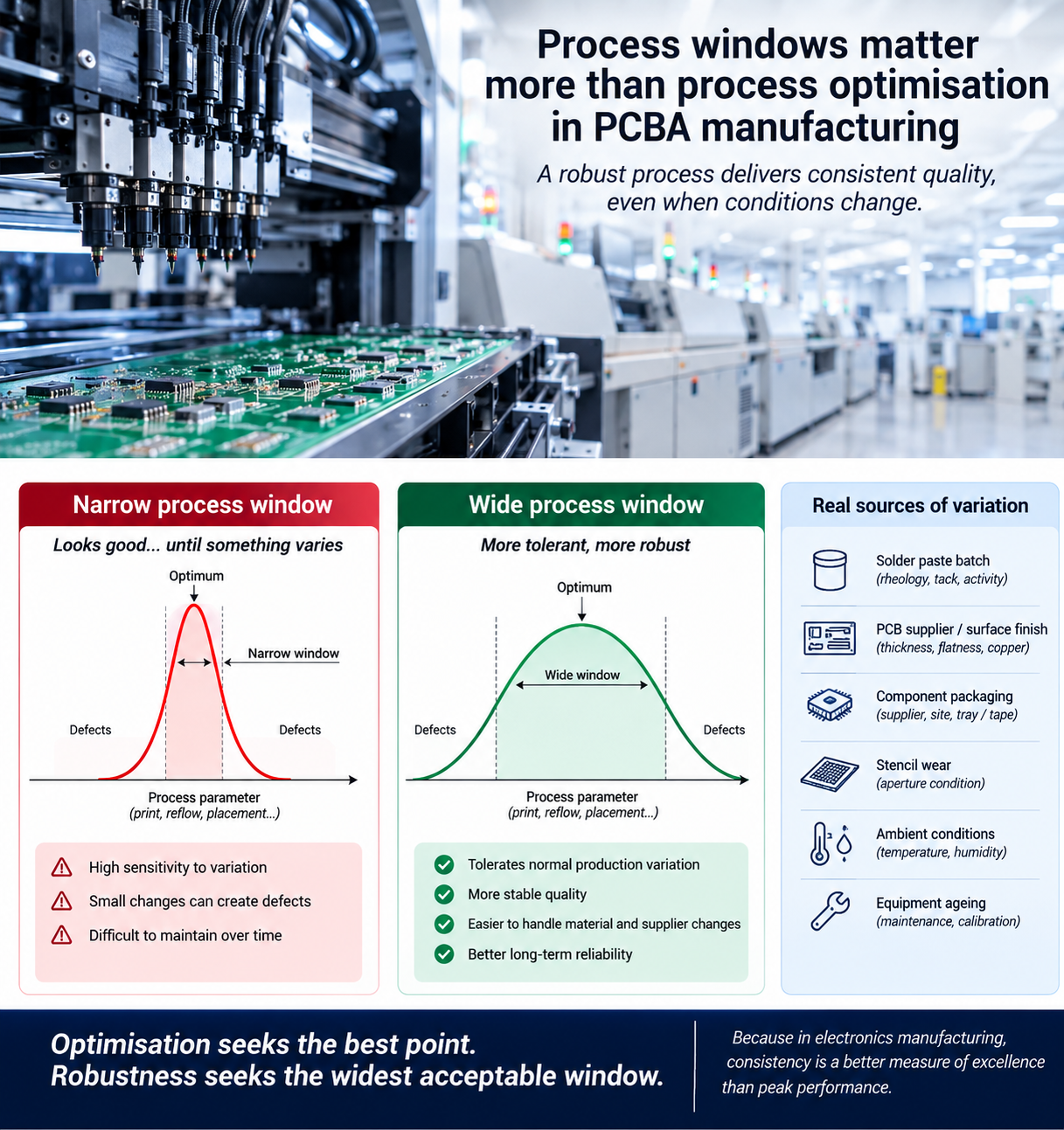
When discussing PCBA manufacturing, we often focus on optimisation. A better stencil design. A refined reflow profile. Improved placement accuracy. A higher First Pass Yield. These are all important objectives, but they don’t necessarily make a manufacturing process robust.
Every assembly process operates within a process window—a range of parameters where acceptable results can be consistently achieved. The wider this window, the more resilient the process is to normal production variability : variability is unavoidable.
A new solder paste lot. Slight differences in PCB thickness. Component packaging changes. Stencil wear. Variations in ambient temperature or humidity. None of these events is exceptional; they are part of everyday manufacturing.
The question is not whether the process can produce a good board under ideal conditions. The real question is whether it will continue to do so when those conditions inevitably change.
This is where I think process optimisation is sometimes misunderstood.
Optimising a process to achieve the best possible result under a specific set of conditions may actually reduce its robustness if the operating margins become too narrow. A process that performs exceptionally well in the laboratory can become surprisingly sensitive on the production floor.
For this reason, I believe manufacturing engineers should spend as much time understanding the boundaries of the process as they do searching for the optimum settings. Where does the process begin to drift ? Which parameter is the most sensitive ? How much variation can it tolerate before defects appear ?
Answering these questions often provides more value than improving First Pass Yield by another fraction of a percent.
Inspection systems such as SPI, AOI and X-ray remain essential, but they should primarily be used to detect process drift rather than compensate for an unstable process. Quality is not created during inspection; it is created by a process that remains under control despite the natural variability of manufacturing.
To me, this is one of the key differences between a process that works and a process that can be trusted over thousands — or millions — of assemblies.
How do you assess process robustness in your manufacturing environment? Do you focus primarily on yield, or on the stability of the process itself ?